
Acclaimed designer revamps children's hospital with Formica® Laminate
British designer Morag Myerscough is known for brightening up hospitals schools and public art installations with her colourful and eye-catching community design projects.
 All Photography by Jill Tate
One of the latest spaces transformed by Morag’s vibrant approach is Sheffield Children’s Hospital where she has enhanced 46 en-suite bedrooms and 6 multi occupancy bays using Formica® laminate. The rooms are part of a series commissioned by Artfelt, The Children’s Hospital Charity’s arts programme, as part of its mission to transform patient experience using art and design.
The creation of bright and visually stimulating walls can help distract children and relieve anxiety during long stays on a ward or before surgery. Aware of the sensitivity required when designing a hospital environment, Morag, working alongside Artfelt Manager, Cat Powell, consulted both staff and patients during the process.
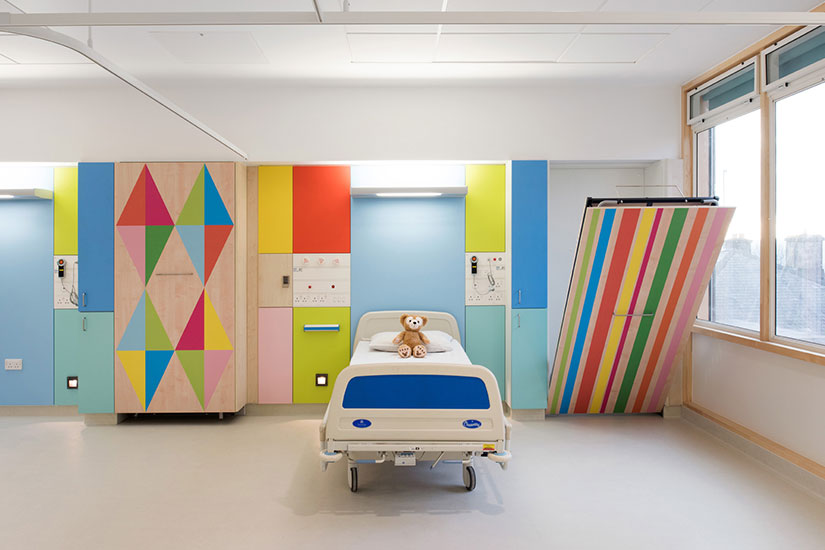
Consideration to clinical factors and the statistics gathered from patients influenced and informed the choice of colours and patterns. Morag comments: “As an artist you can’t lose that vision of how things could be but at the same time you need to take people’s concerns on board. It’s a collaboration rather than a compromise.”
The project provided Morag with a challenge since she had never worked on a bedroom before: “Bedrooms are really complex compared to corridors or more public spaces - especially in a children’s hospital because you’re creating for patients who have various conditions and there are a lot more challenges involved.”
Avanti Architects designed the layout of the new rooms with the aim of making the environment less clinical and more comfortable. The architects specified Formica laminate for the wall cladding to conceal the plugs and wires while incorporating a décor to help promote a more domestic aesthetic. For hospital projects, cleanliness and the provision of a sterile environment is essential. While hygiene concerns meant painting on the walls was not an option, the application of Formica laminate, with its material properties and decor options, meant Morag was not limited in her creative vision.
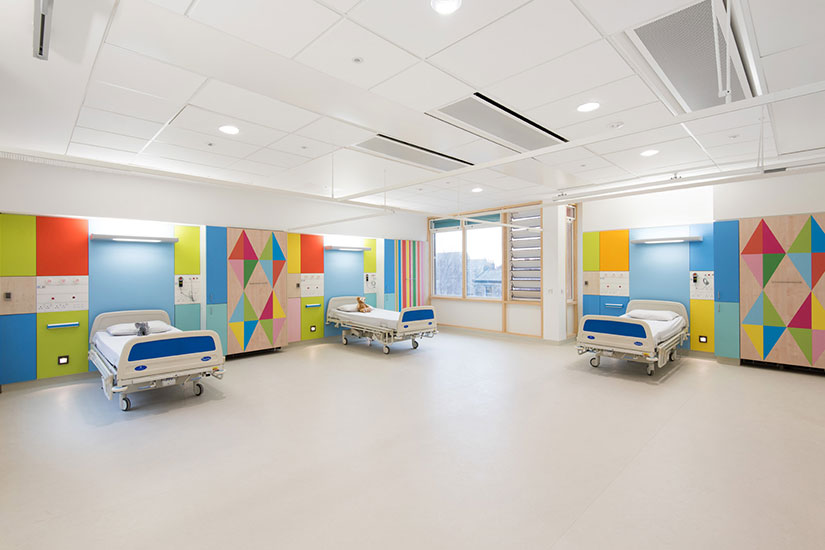
Morag continues: “We scanned the wood grain and then digitally printed the patterns, using the Younique® by Formica Group service. Having made sure the design matched up and that the warmth of the wood grain remained, we then printed onto paper and laminated as normal.”
Formica laminate is easy to clean and requires low maintenance meaning the designs can keep their look for longer and continue to contribute to occupant comfort. The surfacing material was also applied to the ward’s furniture and the atrium.
“Although the rooms are for children I didn’t want them to be childish because children of all different age groups will be staying in them,” says Morag. “I also wanted to create somewhere parents would be happy to spend time too. It was just about making a bedroom that you felt good to be in.”
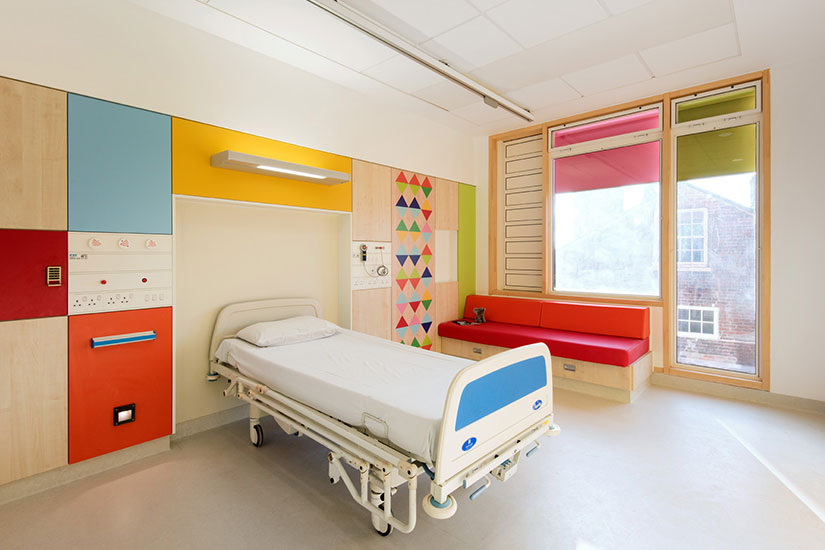
A total of four schemes were designed by Morag. The schemes are rotate throughout the rooms and include colours specifically chosen for children who may have sensory sensitivity or conditions like autism. The project displays an alternative approach to hospital bedroom design and challenges convention. Morag concludes: “From the work I’ve done in healthcare I know that it’s phenomenally positive for people to have art in hospitals.
“Going into a grim and grey room isn’t going to make anybody feel good. But to go into a room that lets you know that people care about you and they’re thinking about you – it’s a no-brainer really. It makes people happier and more assured that everybody is concerned about them and wants them to get better.”


